History of Morse Code
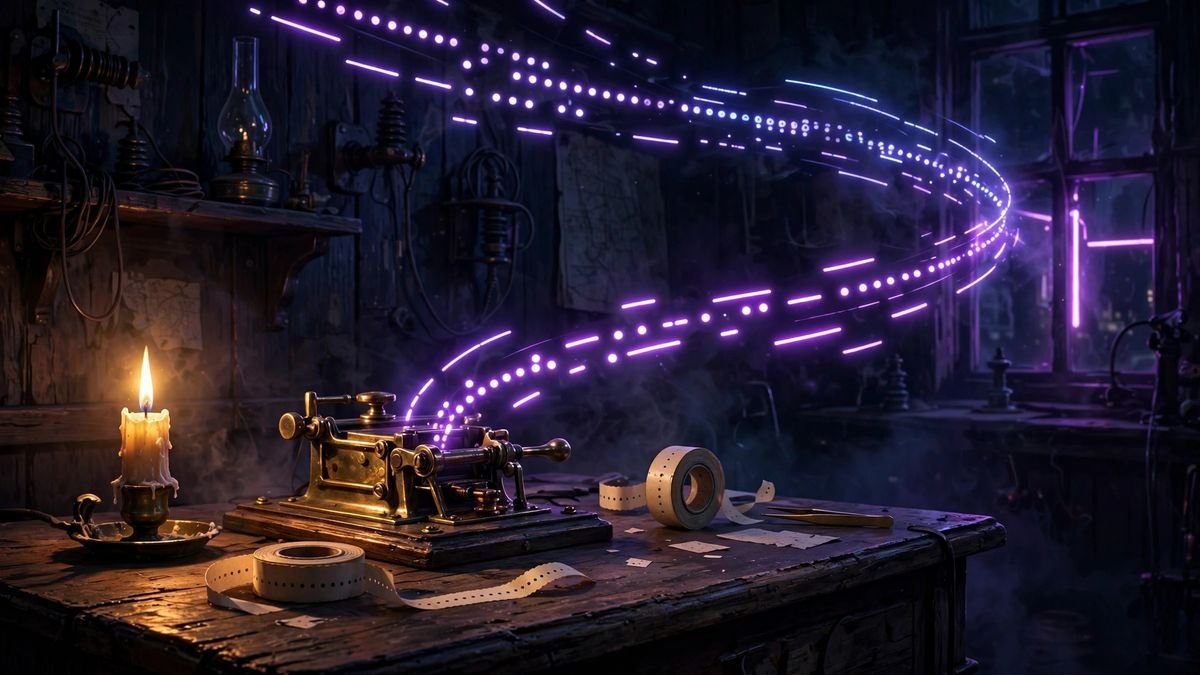
The Code That Refused to Die
Morse code is the oldest digital code still in daily use on Earth. It was born before the telephone, before the light bulb, before the American Civil War — and it outlived the telegraph companies, the maritime radio rooms, and every prediction of its death. It survived because it is brutally efficient: a human ear can pull morse out of noise where voice fails, a $5 key can span continents, and three dots, three dashes, three dots still means help in every country on the planet. This is the full story — the painter who dreamed it, the partner who engineered it, the shipwreck that made it famous, the wars it fought in, the day the ships went silent, and the strange second life it's living right now.
The Timeline
A painter gets an idea on a ship
Samuel Finley Breese Morse is not an inventor — he's one of America's most celebrated portrait painters. Returning from Europe aboard the packet ship Sully, he falls into conversation about electromagnetism and has the lightning thought: what if electrical pulses could carry intelligence along a wire? He spends the rest of the voyage sketching. He is 41 years old, broke, and about to change the world.
Vail builds the code; Congress funds the line
Morse partners with the mechanically gifted Alfred Vail, who does the crucial engineering the history books often skip: designing a practical key and register — and, critically, assigning the shortest codes to the most common letters. Vail reportedly counted the type in a printer's office to measure letter frequency (E got ., T got -), inventing data compression a century before the term existed. In 1843 Congress appropriates $30,000 for an experimental line between Washington and Baltimore.
"What hath God wrought"
From the Supreme Court chamber in the US Capitol, Morse taps out the first public telegraph message to Vail in Baltimore, 40 miles away: "What hath God wrought" — suggested by Annie Ellsworth, from the Bible (Numbers 23:23). The line works. News that once traveled at the speed of a horse now travels at the speed of electricity, and the telegraph era explodes: within a decade, wires lace the continent.
Gerke cleans it up
The original American code is clumsy — it has intra-character spaces and multiple dash lengths, and it breaks down on long lines. German telegraph inspector Friedrich Clemens Gerke reworks it into a cleaner system with uniform timing: the direct ancestor of the morse we use today. The German-Austrian Telegraph Union adopts Gerke's revision.
Paris: one code for the whole world
The International Telegraph Convention meets in Paris and adopts Gerke's system as the worldwide standard — International Morse Code. The same conference founds the International Telegraph Union, the body that becomes today's ITU. From here on, a dot is a dot everywhere on Earth. (The story of the American original it replaced: American Morse.)
Morse goes wireless
Marconi's wireless telegraphy cuts the wire, and morse becomes the native language of radio. Ships — beyond the reach of any cable — adopt it for survival. The need for a universal distress call becomes urgent.
SOS is born
The Berlin Radiotelegraph Convention adopts ...---... as the international distress signal — chosen purely because the pattern is unmistakable, not because the letters stand for anything (every "Save Our Souls" story is a backronym). It takes effect on 1 July 1908. The first recorded rescue using SOS: the Slavonia in 1909.
The Titanic makes SOS immortal
On the night of 14–15 April 1912, the Titanic's wireless operators — Jack Phillips and Harold Bride — send both the old Marconi-company call -.-. --.- -.. (CQD) and the new ...---... (SOS). The disaster sears SOS into global consciousness; from then on, three dots, three dashes, three dots means help to everyone, everywhere. Full story: SOS in morse code.
The wars of the key
Morse fights in both world wars — in trenches, tanks, aircraft, and ships. Skilled operators become strategic assets; intercept stations copy enemy morse around the clock. And in a BBC broadcast, the "V for Victory" campaign turns ...- (V) — the opening rhythm of Beethoven's Fifth — into the most famous four notes of the war, drummed into occupied Europe as a promise.
The ships go silent
The US Coast Guard ends its morse watch in 1995. Then, on 1 February 1999, the Global Maritime Distress and Safety System (GMDSS) officially retires maritime morse worldwide — after more than 90 years of standing watch over the oceans. The era of the professional shipboard "sparks" ends.
No longer required — still loved
The ITU drops the mandatory morse requirement for amateur radio licenses (2003); the US FCC follows in 2007. Pundits predict CW's death. Instead, the bands stay full: freed from being a requirement, morse becomes a choice — and thousands choose it.
The @ sign — 160 years to the day
Exactly 160 years after "What hath God wrought," the ITU formally adds .--.-. (@, "commat") to the code — the first new character in nearly a century, added so operators could exchange email addresses. The AC digraph, for "At Commercial."
The second life
Morse never died — it diversified. Ham operators work the world on milliwatts; aviation beacons (VOR, NDB) identify themselves in morse; accessibility tools put morse keyboards on phones; and the SOS pattern still summons rescuers by flashlight, whistle, or tapping. The code that carried the 19th century's news now hides in ringtones, tattoos, and puzzle games — see below.
Morse Code Today: The Second Life
The obituaries were premature. Here's where the dots and dashes live now:
- Amateur radio (CW). Hundreds of thousands of hams use morse daily — it's the mode that gets through when nothing else will. A 5-watt CW signal can cross oceans; the same power in voice barely leaves the county. Contests like CQ WW CW log millions of morse contacts a year.
- Aviation beacons. VOR and NDB navigation beacons continuously broadcast their identifiers in morse — pilots still learn to recognize the station's callsign by ear. Listen on an airband receiver and you'll hear it.
- Accessibility tech. Morse is a lifeline for people with limited mobility: morse keyboards (including one built into Gboard) let users type with two switches or even eye blinks. Two inputs, infinite expression.
- Emergency signaling. No radio? No problem:
...---...works by flashlight, whistle, mirror, tapping on pipes, or blinking. Rescuers worldwide are trained to recognize it — it's the one morse pattern civilians are expected to know. - Pop culture. Nokia's iconic SMS tone spells
... -- ...(S-M-S); Beethoven's Fifth opens with the V-for-Victory rhythm; morse hides in movie soundtracks, video games, tattoos, and jewelry (see our tattoo & jewelry guide). - Learning & play. The trainer, quiz, and generator on this site exist because a new generation keeps discovering that 182-year-old rhythms are genuinely fun to learn.
Fun Facts Worth Knowing
The inventor was a painter
Before the telegraph, Samuel Morse was one of America's leading portrait artists. He took up inventing partly because portrait commissions dried up — art history's loss was communication history's gain.
The first data compression
Vail assigned the shortest codes to the most frequent letters (E = ., T = -) by counting type in a printer's office — a century before Shannon formalized information theory.
A teenager picked the first message
"What hath God wrought" was suggested by Annie Ellsworth, the young daughter of the US Commissioner of Patents — from Numbers 23:23. Morse, a devout man, loved it.
Billions heard morse daily
Nokia's "Special" SMS tone is ... -- ... — S-M-S in morse. For two decades it was arguably the most-played morse on Earth, and almost nobody knew.
Morse Code Day
27 April — Samuel Morse's birthday (1791). Amateur radio clubs celebrate with on-air events every year.
Beethoven's war motif
The opening of Beethoven's Fifth — ...- — is V in morse. The BBC's WWII "V for Victory" campaign hammered it into occupied Europe as a symbol of resistance.
Frequently asked questions
Who invented morse code?
Samuel F.B. Morse conceived it and built the first systems, but his partner Alfred Vail did much of the technical design in the 1840s — including assigning the shortest codes to the most common letters.
What was the first morse code message?
"What hath God wrought" (from Numbers 23:23), sent by Morse from Washington to Baltimore on 24 May 1844 over the first US telegraph line.
When did morse code become the world standard?
In 1865, when the International Telegraph Convention in Paris adopted the modern code — based on Friedrich Gerke's 1848 revision — and founded the International Telegraph Union, today's ITU.
Did the Titanic send SOS?
Yes — along with the older CQD (-.-. --.- -..). SOS had been the international distress standard since 1908, and the Titanic disaster in 1912 is what made it world-famous.
When did ships stop using morse code?
Officially in 1999, when the Global Maritime Distress and Safety System (GMDSS) replaced morse for maritime distress. The US Coast Guard had ended its morse watch in 1995.
When was the @ sign added to morse code?
Formally on 24 May 2004 — the 160th anniversary of the first telegraph message — as .--.-., so operators could send email addresses.
Is morse code still used today?
Yes: amateur radio operators use it daily, aviation beacons identify themselves in morse, it powers accessibility tools like morse keyboards, and the SOS pattern remains the universal distress signal.
What is Morse Code Day?
27 April — Samuel Morse's birthday — celebrated by enthusiasts and amateur radio clubs with on-air events.
Now Learn the Code Yourself
History is prologue — the code is still alive and learnable. Start with what morse code is, meet the full alphabet, decode the most famous signal ever sent at SOS, or jump straight into the trainer.